 TheAI
TheAIWe asked ~50 GPU providers for B300 pricing. Here's the map
Before building our own cloud, we sent the same question to about fifty GPU providers: 8× B300 nodes, short-to-mid term — what's your price? This is what the market actually looks like.

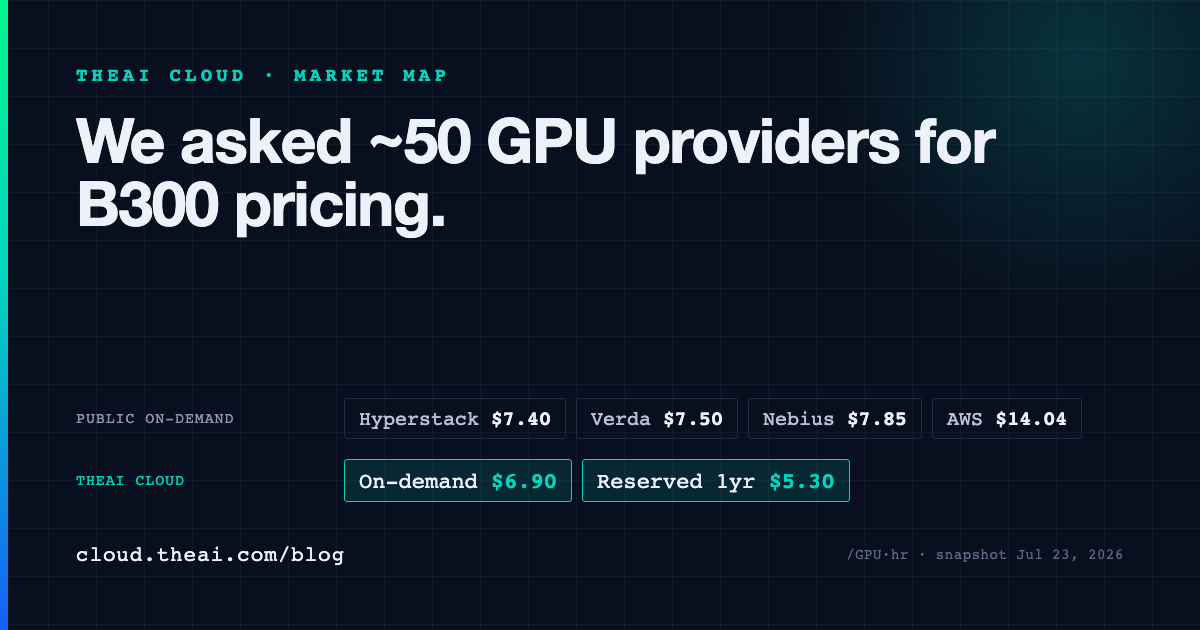
Before we committed to building TheAI Cloud, we did the only sensible thing: we went shopping. Over June and July 2026 we contacted roughly fifty GPU providers — hyperscalers, neoclouds, bare-metal shops, brokers and marketplaces — with the same question every time: "8× B300 nodes, short-to-mid term — what's your price?"
We expected a price list. What we got instead was a map of a market that sells three things — expensive, locked-in, and out of stock — and often all three at once. Here is that map, with numbers.
Methodology, briefly
Same ask to everyone: whole nodes of 8× NVIDIA B300 SXM, terms from on-demand to 12 months, US or EU deployment. We collected public pricing pages where they exist, direct quotes where they don't, and marketplace listings where capacity trades openly. Public numbers below are as of July 23, 2026 — this market moves, so treat every figure as a dated snapshot, not gospel. Private quotes are aggregated and anonymized; we don't publish other people's confidential numbers, only the shape they form together.
The visible market: public on-demand
Only a handful of providers publish an on-demand B300 price at all. As of the snapshot:
| Provider | On-demand, $/GPU·hr |
|---|---|
| Hyperstack | $7.40 |
| Verda | $7.50 |
| Nebius | $7.85 |
| AWS (Capacity Blocks) | $14.04 |
Independent price trackers put the market median around $7.85/GPU·hr — up roughly 57% since November. The floor across trackers has hovered in the $6.94–7.39 range for months. That's the market you can see with a browser.
It is worth pausing on the AWS number: a Capacity Block at $14.04 is roughly double the neocloud rate for the same silicon. That premium buys ecosystem integration, not faster matrix multiplies.
The invisible market: where the cheap B300s live
Everyone has heard that B300s trade "below $5". It's true — and almost none of it is rental.
Every quote we received under $5.50/GPU·hr came with the same structure: a 2-to-5-year commitment and a 20–40% down payment, wired up front. At that point you're not renting a GPU; you're taking out a mortgage on one, with the residual-value risk quietly transferred to you. Given how fast this hardware generation cycle runs — look up what an H100 rents for today versus its 2023 sticker — a five-year lock on any accelerator is a bet most teams shouldn't be making.
And the middle of the term curve is nearly empty. Twelve-month wholesale offers — the term most teams actually want — were almost extinct in our scan: single digits of offers across ~50 providers. The market has bifurcated into "right now, at a premium" and "half a decade, at a discount," with very little honest ground between.
The giants don't sell small
CoreWeave and Lambda both quote B300 reserved capacity via sales only: no public price, no self-serve, and volume minimums that start conversations well above a node or two. The typical enterprise route we observed runs 2–4 weeks from first inquiry to a quote in hand.
That's a fine process if you're deploying thousands of GPUs on a yearly plan. If you need eight GPUs next week, the top of the market simply doesn't answer the phone.
Listed ≠ available
The subtlest finding, and the one price tables never show: a published on-demand price is not the same thing as an available GPU.
A meaningful share of "on-demand B300" listings today lead to a queue, a "request access" form, or quiet regional stockouts. The price is real; the GPU isn't. You can be looking at a $7+ rate and be unable to deploy at any price — expensive and out of stock at the same time. When you evaluate a provider, the question isn't "what's the number on the page" but "what happens when I click launch."
How to actually read this market
Four rules we'd give any team budgeting Blackwell capacity right now:
- Match the commitment to your real horizon. If your roadmap is 6–12 months, a 3-year contract isn't a discount — it's inventory risk you're holding for someone else.
- Price the down payment, not just the rate. $4.50/hr with 40% of three years wired up front is a very different cash-flow animal from $5.50/hr billed monthly.
- Ask what "available" means. Get a delivery date in writing, and ask what happens if it slips. Acceptance testing before billing starts should be table stakes.
- Treat today's rates as perishable. This market repriced ~57% in eight months. Any budget built on a screenshot will be wrong in one direction or the other — build in re-quote points.
The gap, and what we're doing about it
Our takeaway from fifty conversations: the market offers "expensive," "3-year lock-in," and "out of stock" — frequently all at once. The middle — honest short and mid terms, at honest prices, with an honest availability date — is nearly vacant.
That gap is the company. TheAI Cloud sells whole bare-metal nodes of 8× B300 SXM6 288GB (rate card) on 24- or 36-month reserved terms; on-demand is planned (date TBA — no on-demand price is published yet). The rate is flat for the whole term — $5.00/GPU·hr on 24 months, $4.70 on 36 — with 30% at signing.
Reservations are open: request a configuration, get a written quote within 24 hours; a 30% prepayment then locks slot and rate. On-demand is planned (date TBA). The full grid, including a machine-readable pricing API, is at cloud.theai.com.
We'll keep publishing what we see in this market — the scan didn't stop when we picked a side.
FAQ
Why are 3-year B300 contracts so much cheaper than short terms?
Because you're absorbing the seller's risk. A multi-year take-or-pay contract with a large down payment guarantees the capacity owner their payback regardless of where GPU prices go — so they price the certainty in. Short terms leave the residual-value risk with the provider, and that flexibility is what the premium buys.
Is sub-$5/GPU·hr B300 real?
The quotes are real; the product is different. In our scan, effectively every sub-$5.50 figure required a 2–5 year commitment with 20–40% prepaid. As a spot or monthly rental price, sub-$5 B300 essentially does not exist publicly today.
What's a fair B300 price right now?
For genuinely available on-demand capacity: public rates cluster at $6.94–7.85/GPU·hr. For 6–12 month reserved terms without multi-year lock-in, we consider $5.30–5.50 honest — that's where we priced ours.
Why do availability dates matter more than prices?
Because a price without capacity is just a number on a page. A provider that states a delivery window in writing — and ties billing to acceptance rather than to the calendar — is giving you something enforceable. A queue behind a price tag isn't.